Golden Temple: A Living Symbol of Faith, Equality, and Humanity
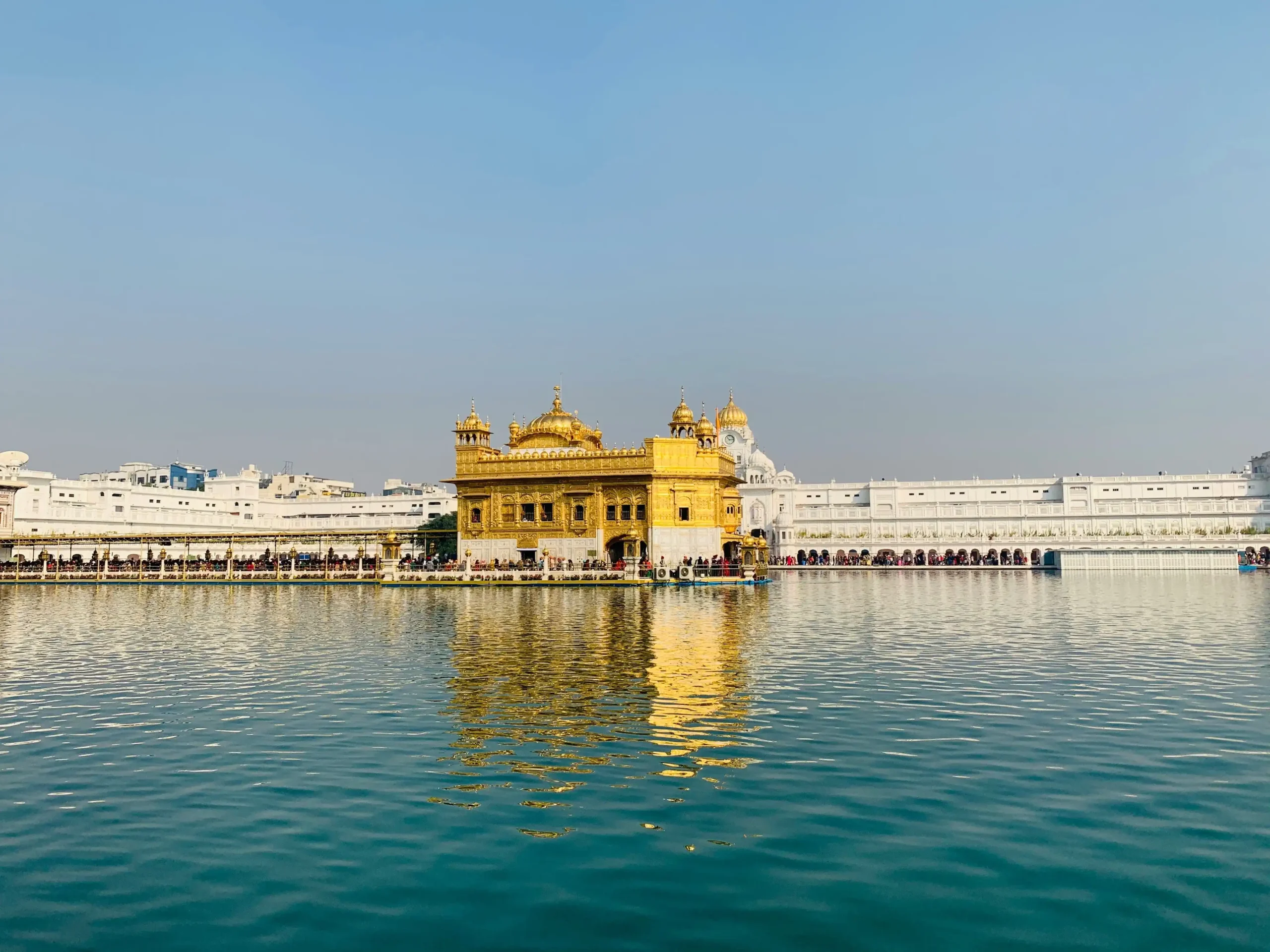
Imagine standing beside a calm pool of crystal-clear water as the first rays of the morning sun gently touch a magnificent shrine covered in gold. The sacred hymns of Sikhism echo through the air, creating an atmosphere of peace unlike anywhere else in the world. Volunteers quietly serve thousands of visitors with smiles, while people from every religion, nationality, and background sit together to share a simple meal without any distinction.
This is not just another religious monument—it is the Golden Temple, also known as Sri Harmandir Sahib or Darbar Sahib, the holiest shrine of Sikhism and one of India’s most treasured landmarks.
For Sikhs, the Golden Temple is the spiritual center of their faith. For historians, it tells a remarkable story of courage, resilience, and sacrifice. For travelers, it is among the most breathtaking destinations in the world. And for millions of visitors every year, it is a place where peace, equality, and selfless service come alive.
Unlike many famous monuments admired only for their architecture, the Golden Temple continues to thrive as a living place of worship. Every prayer, every volunteer, every meal served in its community kitchen, and every visitor who walks through its gates contributes to its timeless legacy.
Whether you are interested in history, architecture, spirituality, or travel, the Golden Temple offers an unforgettable experience that touches both the mind and the heart.
Why Is It Called the Golden Temple?
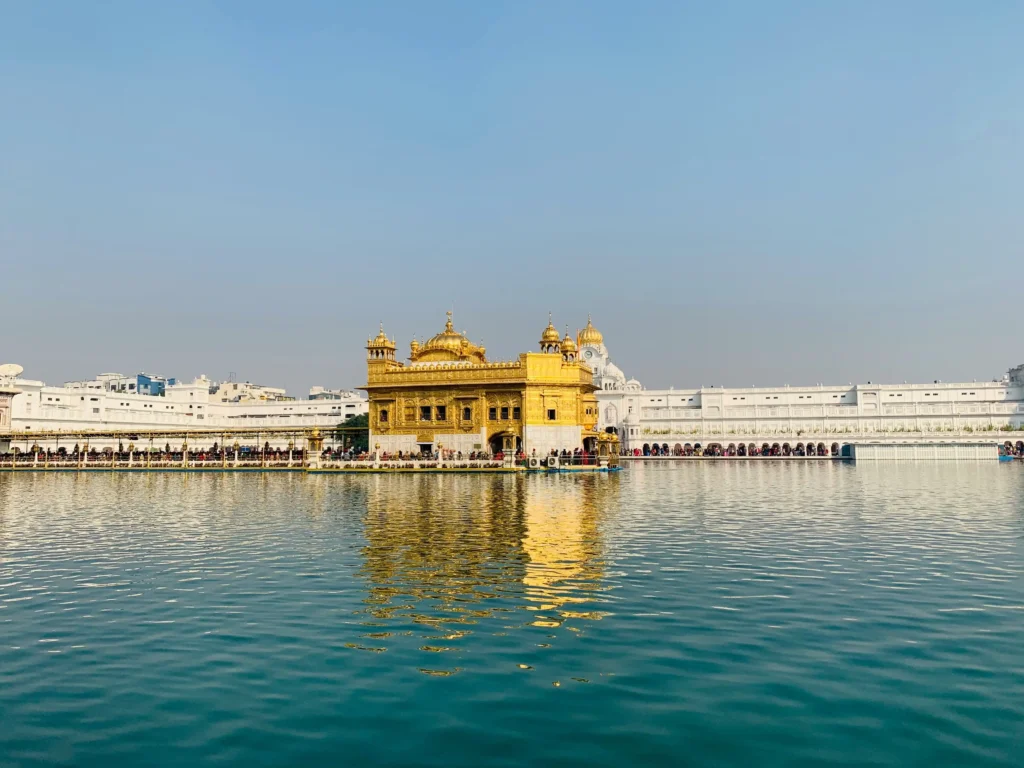
Although its official name is Sri Harmandir Sahib, the shrine is popularly known as the Golden Temple because its upper structure is beautifully covered with gold.
In the early 19th century, Maharaja Ranjit Singh sponsored a major renovation of the shrine. Marble replaced earlier materials in many sections, and the sanctum was covered with gold, giving the temple its iconic appearance that people recognize today.
When sunlight reflects from the golden walls onto the surrounding Amrit Sarovar, the temple creates one of the most mesmerizing sights in India.
Understanding the Meaning of “Harmandir Sahib”
The name Harmandir Sahib has deep spiritual significance.
- Hari means God.
- Mandir means house or temple.
- Sahib is a respectful title.
Together, the name means “The House of God.”
Unlike many temples around the world that welcome only followers of a particular religion, Harmandir Sahib welcomes everyone without discrimination.
This principle of openness forms the foundation of Sikh philosophy.
The Birth of Sikhism
To understand the Golden Temple, it is important to understand the origins of Sikhism.
Sikhism was founded in the 15th century by Guru Nanak, who preached that there is one God and that all human beings are equal. He rejected divisions based on caste, religion, wealth, and social status, emphasizing honesty, compassion, humility, and service to others.
His teachings were carried forward by nine successive Gurus, each contributing to the growth of the Sikh community. By the time of the fourth and fifth Gurus, the need for a central place of worship had become increasingly important.
The Vision of Guru Amar Das
The story of the Golden Temple begins before the temple itself.
The third Sikh Guru, Guru Amar Das, envisioned creating a spiritual center where people from every background could gather in equality and devotion.
He identified a site that would later become the city of Amritsar. This area was then a quiet settlement surrounded by forests and small villages. His vision laid the foundation for one of the most important pilgrimage sites in the world.
Guru Ram Das and the Foundation of Amritsar
In 1574, Guru Ram Das became the fourth Sikh Guru and continued Guru Amar Das’s vision.
He established a new settlement called Ramdaspur, which later became Amritsar.
One of his first projects was to excavate a large sacred tank, later known as the Amrit Sarovar, meaning “Pool of Nectar.”
This sarovar would eventually become the heart of the Golden Temple complex.
Merchants, craftsmen, and families from different regions of India were encouraged to settle in the new town. Over time, Ramdaspur flourished into a vibrant spiritual and commercial center.
The Construction of the Sacred Pool
The excavation of the sacred pool was not merely an engineering project—it was an act of collective devotion.
Thousands of followers participated through Seva, or voluntary service, donating their time and effort without expecting anything in return.
This tradition of selfless service continues at the Golden Temple to this day.
Today, the Amrit Sarovar surrounds the shrine, creating the breathtaking reflection that has become one of the most iconic images of India.
Guru Arjan Dev and the Construction of Harmandir Sahib
The fifth Sikh Guru, Guru Arjan Dev, transformed the vision into reality.
Construction of the temple began in 1581.
Unlike traditional temples that are built on elevated platforms, Guru Arjan deliberately designed Harmandir Sahib at a lower level than the surrounding land.
This decision carried a profound spiritual message:
Anyone who wishes to enter the House of God must first humble themselves.
Even today, every visitor walks down a few steps before entering the shrine, symbolizing humility before the Divine.
The Four Gates: A Revolutionary Idea
Perhaps the most unique feature of the Golden Temple is its four entrances, facing north, south, east, and west.
During the 16th century, Indian society was deeply divided by caste and social hierarchy. Many places of worship restricted access based on birth or status.
Guru Arjan rejected these barriers.
The four gates symbolize that people from every direction, every religion, every caste, and every walk of life are equally welcome.
This message of equality remains one of the defining principles of Sikhism.
Installation of the Adi Granth
A defining moment in the temple’s history came in 1604.
Guru Arjan compiled the Adi Granth, the first version of the Sikh holy scripture, containing the teachings of Sikh Gurus along with devotional compositions from saints of different backgrounds.
The scripture was ceremonially installed inside Harmandir Sahib, making the shrine the spiritual heart of Sikhism.
Baba Buddha was appointed as the first Granthi (custodian and reader of the scripture), marking the beginning of a tradition that continues today.
A Temple Open to All
One of the most remarkable aspects of the Golden Temple is its universal message.
Regardless of religion, nationality, language, gender, or social status, everyone is welcome.
Visitors are asked only to:
- Cover their heads.
- Remove their shoes.
- Wash their feet before entering.
- Show respect for the sacred surroundings.
This openness has made the Golden Temple not only a place of worship but also a global symbol of unity, compassion, and human dignity.
The Golden Temple Becomes the Spiritual Center of Sikhism
After the installation of the Adi Granth in 1604 by Guru Arjan Dev, Harmandir Sahib became the spiritual center of the Sikh community.
Pilgrims from different parts of India began traveling to Amritsar to seek blessings and listen to the sacred hymns. The city quickly developed into an important center for trade, education, and spirituality.
However, the growing influence of Sikhism also attracted the attention of the powerful Mughal Empire.
The Martyrdom of Guru Arjan Dev
One of the darkest chapters in Sikh history unfolded in 1606.
The Mughal Emperor Jahangir viewed the increasing popularity of Guru Arjan Dev with suspicion. Historical records indicate that the Guru was arrested after being accused of supporting Prince Khusrau, who had rebelled against the emperor. He was also pressured to alter Sikh teachings and convert to Islam, which he refused.
Guru Arjan Dev endured severe torture before attaining martyrdom in Lahore in 1606. He is remembered as the first Sikh Guru to attain martyrdom, and his sacrifice became a defining moment in Sikh history.
Following this event, the Sikh community recognized the need not only for spiritual strength but also for the ability to defend itself against oppression.
Guru Hargobind and the Rise of Sikh Resistance
After Guru Arjan Dev’s martyrdom, his son Guru Hargobind became the sixth Sikh Guru.
Guru Hargobind introduced the concept of Miri-Piri, which represents the balance between spiritual authority (Piri) and temporal or worldly authority (Miri). He encouraged Sikhs to remain devoted to God while also being prepared to protect justice and defend the oppressed.
To symbolize this philosophy, he established the Akal Takht directly opposite Harmandir Sahib in 1606. The Akal Takht became the highest seat of temporal authority in Sikhism, where important community decisions and declarations could be made.
The presence of both Harmandir Sahib and the Akal Takht in the same complex beautifully reflects the Sikh ideal of combining spirituality with responsibility.
The Mughal Attacks on Harmandir Sahib
As the Sikh community grew stronger, tensions with the Mughal rulers increased.
Throughout the 17th century, Harmandir Sahib faced repeated threats. Several Sikh leaders and followers were persecuted, and the temple became a focal point of resistance against oppression.
Although the shrine suffered damage during various conflicts, the Sikh community remained committed to restoring it each time.
These repeated acts of destruction and reconstruction strengthened the emotional bond between the Sikhs and their holiest shrine.
The Eighteenth Century: A Time of Great Hardship
The 18th century proved to be one of the most difficult periods in Sikh history.
Following the decline of the Mughal Empire, northern India witnessed frequent invasions by Afghan forces. Among the most feared invaders was Ahmad Shah Durrani, also known as Ahmad Shah Abdali.
Between 1748 and 1767, he invaded India multiple times.
The Golden Temple became one of his primary targets because he understood its immense religious importance to the Sikh community.
The Destruction by Ahmad Shah Durrani
In 1757, Ahmad Shah Durrani attacked Amritsar and desecrated Harmandir Sahib.
Historical accounts describe how the sacred complex was damaged, and the holy Amrit Sarovar was polluted in an attempt to insult Sikh religious sentiments.
Yet, as soon as the invading army departed, Sikh volunteers returned to clean the sacred pool and rebuild the shrine.
Their determination demonstrated that physical destruction could never destroy their faith.
The Explosion of 1762
One of the most devastating attacks occurred in 1762.
After defeating Sikh forces in the conflict known as the Wadda Ghallughara (Great Holocaust), Ahmad Shah Durrani marched to Amritsar and ordered Harmandir Sahib to be blown up with gunpowder.
The sacred shrine was almost completely destroyed.
Many believed that Sikhism would never recover from such a devastating loss.
History, however, would prove otherwise.
The Spirit of Reconstruction
Almost immediately after the Afghan army withdrew, Sikh leaders and ordinary devotees returned to Amritsar.
Without waiting for political stability or royal support, they began rebuilding Harmandir Sahib through voluntary labor and community donations.
This tradition of rebuilding the temple through collective effort became one of the defining characteristics of Sikh history.
The destruction of the shrine only strengthened the Sikh community’s determination to preserve their faith.
The Heroic Sacrifice of Baba Gurbaksh Singh
One of the most inspiring stories associated with this period is that of Baba Gurbaksh Singh.
When Ahmad Shah Durrani attacked Amritsar in 1764, Baba Gurbaksh Singh and a small group of Sikh warriors chose to defend the Golden Temple despite being heavily outnumbered.
They fought bravely until their last breath.
Although they could not stop the invading army, their sacrifice became a lasting symbol of courage and devotion.
Today, their bravery continues to inspire generations of Sikhs around the world.
Jassa Singh Ahluwalia and the Rebuilding of the Temple
After the Afghan invasions, the responsibility of rebuilding Harmandir Sahib was taken up by Jassa Singh Ahluwalia.
With contributions from Sikhs across Punjab, the temple was reconstructed once again.
The sacred tank was cleaned, new pathways were built, and Harmandir Sahib gradually regained its place as the spiritual heart of Sikhism.
This reconstruction marked the beginning of a new era for the Sikh community.
Maharaja Ranjit Singh and the Golden Era
Perhaps no individual contributed more to the present appearance of the Golden Temple than Maharaja Ranjit Singh.
After establishing the Sikh Empire, Maharaja Ranjit Singh visited Harmandir Sahib and pledged to restore it on a grand scale.
His vision was not merely to repair the shrine but to transform it into one of the most magnificent religious monuments in the world.
The Marble Reconstruction
In the early 19th century, extensive renovation work began.
The temple’s walls and floors were rebuilt using high-quality white marble. Skilled craftsmen from different regions of India were invited to decorate the shrine with intricate carvings, floral patterns, and precious stone inlay work.
The renovation preserved the temple’s spiritual simplicity while enhancing its artistic beauty.
Why Is the Temple Covered in Gold?
The feature that gives the Golden Temple its worldwide identity was introduced during Maharaja Ranjit Singh’s reign.
Around 1830, he donated large quantities of gold to cover the upper portion of Harmandir Sahib.
Thin sheets of gold were carefully applied over copper plates, creating the magnificent golden exterior visible today.
This generous contribution earned the shrine its popular name—the Golden Temple.
A Masterpiece of Art and Architecture
During Maharaja Ranjit Singh’s renovation, artists decorated the temple with:
- Delicate floral carvings
- Gold-plated ceilings
- Marble inlay work
- Mirror decorations
- Religious frescoes
- Copper engravings
- Semi-precious stone artwork
Even today, visitors are amazed by the extraordinary craftsmanship displayed throughout the shrine.
The British Period
After the fall of the Sikh Empire in 1849, Punjab came under British rule.
The British made several changes to the surroundings of Harmandir Sahib.
One of the most notable additions was a Gothic-style clock tower constructed near the main entrance. Although many Sikhs considered it architecturally unsuitable, it remained for several decades before being replaced with a more traditional entrance that harmonized with the temple’s design.
Despite colonial rule, the Golden Temple continued to serve as the spiritual center of Sikhism.
The Singh Sabha Movement
During the late 19th century, Sikh scholars and religious leaders launched the Singh Sabha Movement to revive Sikh traditions and preserve the distinct identity of the faith.
The Golden Temple became the focal point of this reform movement.
The movement encouraged the study of Sikh scriptures, strengthened religious education, and promoted the management of gurdwaras according to Sikh traditions.
Its influence continues to shape Sikh institutions today.
The Jallianwala Bagh Connection
One of the most tragic events in India’s freedom struggle occurred just a short distance from the Golden Temple.
On 13 April 1919, thousands of people had gathered near Jallianwala Bagh after visiting Harmandir Sahib during the festival of Vaisakhi.
British troops under Reginald Dyer opened fire on the unarmed gathering without warning.
Hundreds of people were killed, while many more were injured.
The massacre deeply affected the Sikh community and strengthened the movement for India’s independence.
Formation of the SGPC
To ensure that Sikh shrines were managed by the Sikh community itself, the Shiromani Gurdwara Parbandhak Committee was established in 1920.
The SGPC continues to manage Harmandir Sahib and many other historic gurdwaras in Punjab.
Its responsibilities include:
- Daily management of the temple
- Organizing religious ceremonies
- Preserving Sikh heritage
- Managing the Langar
- Maintaining the complex
Operation Blue Star (1984): A Sensitive Chapter
One of the most significant and painful events in the modern history of the Golden Temple occurred in June 1984 during Operation Blue Star.
At that time, armed militants led by Jarnail Singh Bhindranwale had taken positions inside parts of the Golden Temple complex. The Government of India, led by Indira Gandhi, ordered the Indian Army to enter the complex to remove the militants.
The military operation caused heavy damage to the complex, including the Akal Takht, and resulted in the deaths of soldiers, militants, and civilians.
The events of June 1984 remain deeply emotional and sensitive for many people. They continue to be remembered as one of the most significant chapters in modern Sikh history.
In the years that followed, the damaged structures, including the Akal Takht, were rebuilt, and the Golden Temple once again became a place of worship and peace.
The Golden Temple Today
Today, the Golden Temple stands as a symbol of resilience and hope.
Despite centuries of invasions, destruction, and political turmoil, it continues to welcome millions of visitors every year. Its message remains unchanged: humility, equality, compassion, and service to humanity.
The temple’s remarkable journey—from repeated destruction to magnificent restoration—reflects the enduring strength of the Sikh community and its unwavering faith.
The Magnificent Architecture of the Golden Temple: Every Structure, Symbol, and Sacred Place Explained
The Golden Temple is not merely one of the most beautiful religious monuments in the world—it is a masterpiece of architecture where every wall, pathway, doorway, and dome carries a profound spiritual meaning.
Unlike many historic monuments built to showcase the power of kings or emperors, the Golden Temple was designed to reflect the Sikh principles of humility, equality, devotion, and service. Every architectural element serves a purpose beyond aesthetics, reminding visitors that true greatness lies in simplicity and compassion.
Today, the Golden Temple complex covers approximately 67 acres, making it one of the largest and most significant religious sites in India. Every year, millions of devotees and tourists walk through its sacred grounds to experience not only its architectural brilliance but also the peace that surrounds it.
The Architectural Philosophy of the Golden Temple
The Golden Temple is unique because it blends several architectural traditions into one harmonious design.
Its construction reflects influences from:
- Sikh Architecture
- Mughal Architecture
- Rajput Architecture
- Indo-Islamic Architecture
- Traditional Punjabi craftsmanship
Rather than copying one style completely, the builders combined the finest features of each tradition to create something entirely unique.
The result is a monument that represents harmony rather than division.
Why Is the Temple Built Below Ground Level?
One of the first things visitors notice is that they must walk down a few steps before entering the main shrine.
This was an intentional decision made by Guru Arjan Dev.
Most temples around the world are constructed on elevated platforms to symbolize greatness.
The Golden Temple does exactly the opposite.
Here, visitors descend before entering.
This simple architectural feature teaches an important lesson:
Before entering the house of God, one must first let go of pride and embrace humility.
This philosophy remains one of the defining characteristics of Sikhism.
The Four Entrance Gates
One of the most revolutionary architectural features of the Golden Temple is its four entrance gates, each facing one of the four cardinal directions.
During the sixteenth century, many places of worship restricted entry based on caste, religion, or social status.
Guru Arjan Dev challenged this practice.
The four entrances symbolize that:
- Every religion is welcome.
- Every caste is equal.
- Every nationality is respected.
- Every human being has equal access to God.
Even today, these gates remain one of the strongest symbols of universal brotherhood.
The Sacred Amrit Sarovar
6
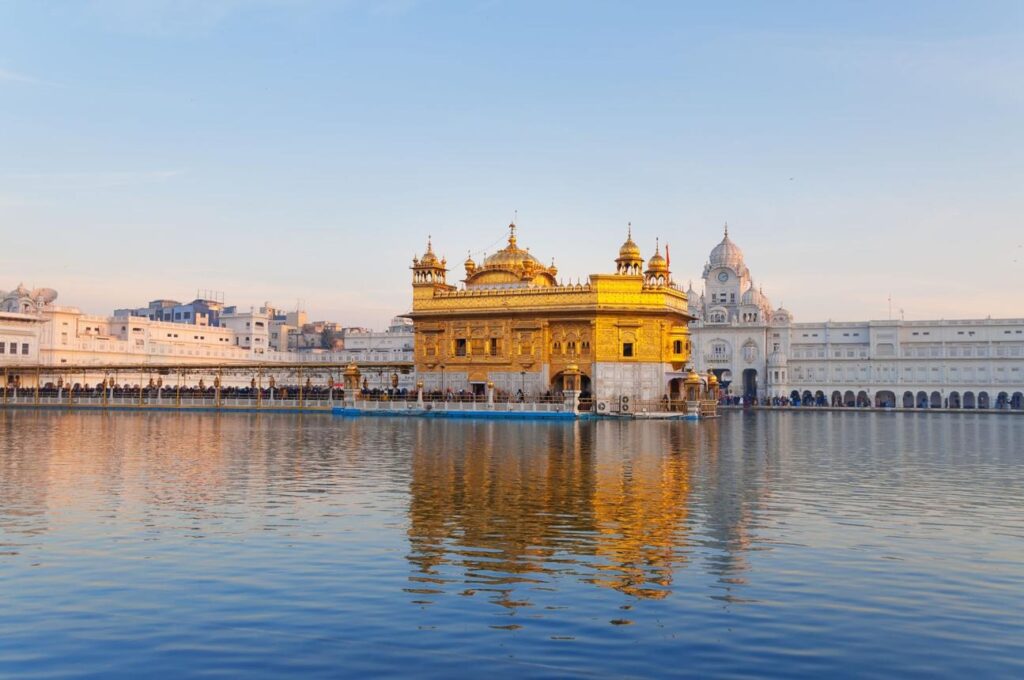
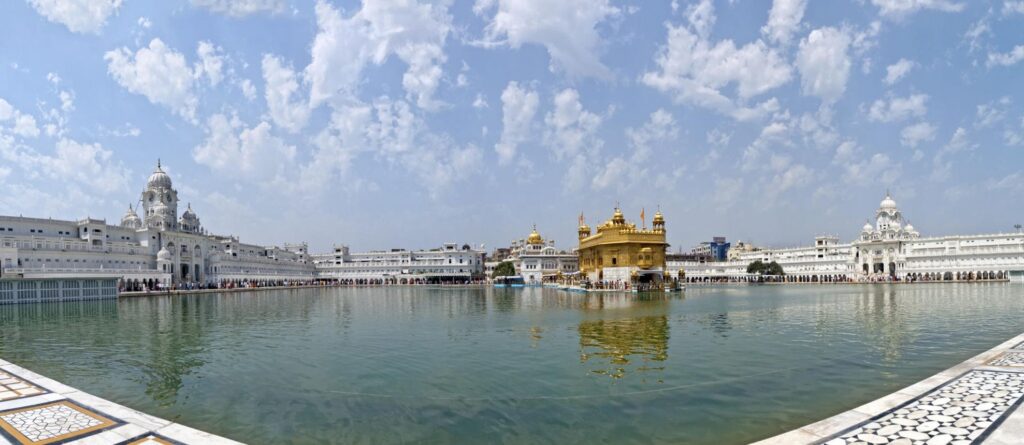
At the center of the Golden Temple complex lies the sacred Amrit Sarovar, from which the city of Amritsar derives its name.
The word Amrit means nectar of immortality, while Sarovar means sacred pool.
The excavation of this pool began during the time of Guru Ram Das and was completed under Guru Arjan Dev.
Today, the Sarovar surrounds the Golden Temple on all sides, creating its world-famous reflection.
Religious Importance
For Sikhs, the Sarovar represents spiritual purification.
Many devotees take a ceremonial dip before entering the shrine. While this act is rooted in faith rather than a guaranteed physical benefit, it symbolizes inner cleansing and devotion.
The calm waters also create an atmosphere of serenity that enhances the spiritual experience.
The Marble Parikrama
Surrounding the Amrit Sarovar is a broad white marble pathway known as the Parikrama.
This pathway circles the sacred pool and allows devotees to walk peacefully around the shrine while praying or reflecting.
The marble flooring is decorated with:
- Floral carvings
- Geometric designs
- Traditional Sikh artwork
- Beautiful inscriptions
Walking along the Parikrama is considered an important part of the pilgrimage, offering visitors time for quiet contemplation.
The Causeway (Guru’s Bridge)
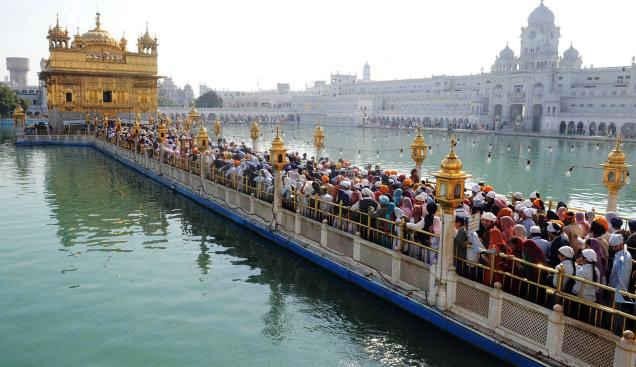
Connecting the Parikrama to the Golden Temple is a narrow marble bridge known as the Causeway or Guru’s Bridge.
Only one pathway leads directly to the sanctum.
This symbolizes that, although people may come from many directions, the path to God is ultimately one.
As visitors cross the bridge, they gradually leave behind the distractions of the outside world and enter a space dedicated to prayer and reflection.
Darshani Deori – The Main Gateway
Before reaching the shrine, visitors pass through the Darshani Deori, an elaborately decorated gateway.
This entrance features:
- Intricate marble carvings
- Decorative arches
- Gold embellishments
- Traditional Sikh motifs
The gateway serves as a transition from the bustling complex into the sacred inner sanctuary.
The Sanctum (Main Shrine)
At the heart of the complex stands the Golden Temple itself.
Although it appears large from a distance, the sanctum is surprisingly compact, emphasizing intimacy and devotion rather than grandeur.
The shrine consists of two principal levels:
Ground Floor
The ground floor houses the Guru Granth Sahib, which is respectfully placed beneath a richly decorated canopy.
Throughout the day, devotional hymns (Kirtan) are sung continuously, creating a peaceful atmosphere that resonates throughout the complex.
Upper Floor
The upper floor is used for scripture reading and religious study.
Its walls and ceilings are adorned with exquisite gold work, painted panels, and floral designs.
The Golden Dome
4
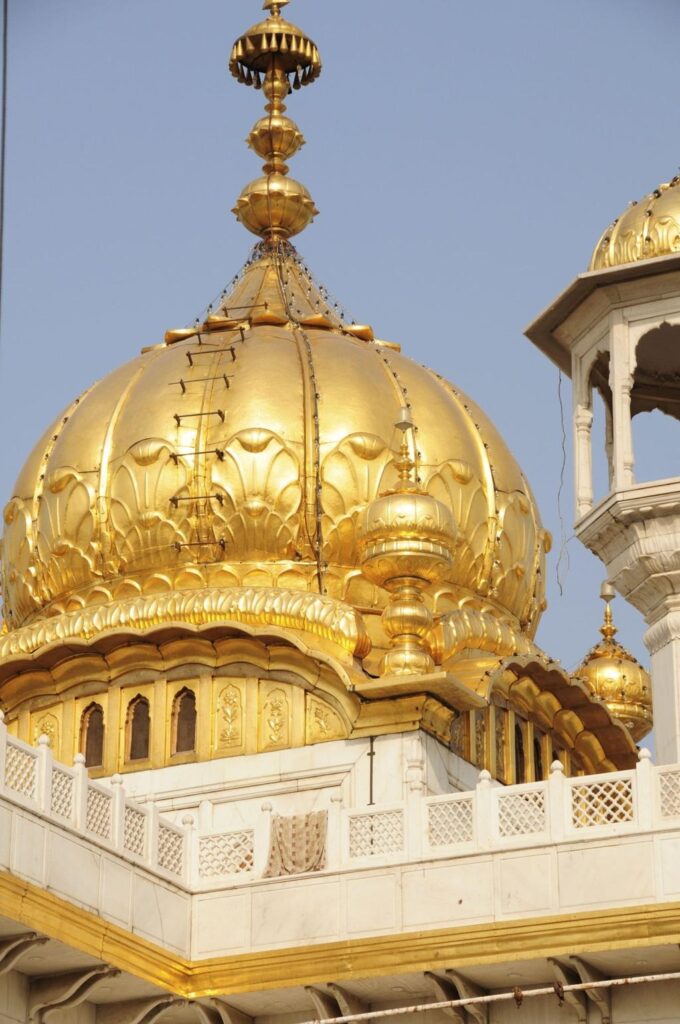
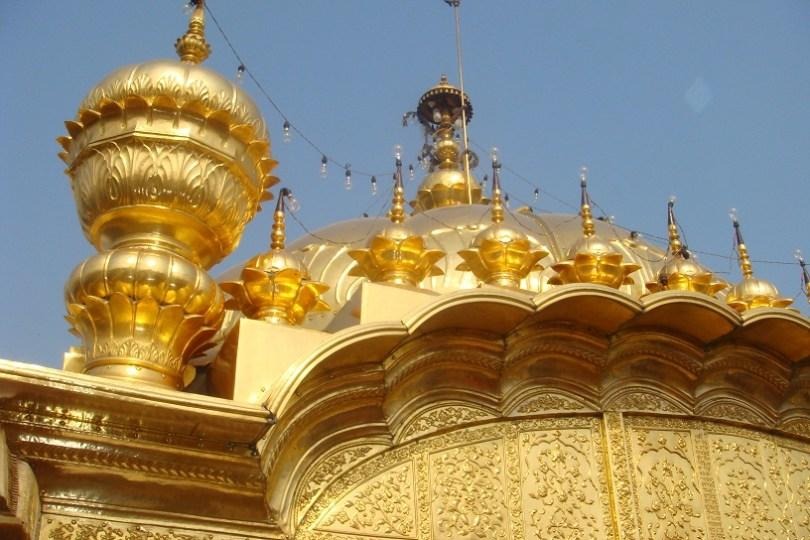
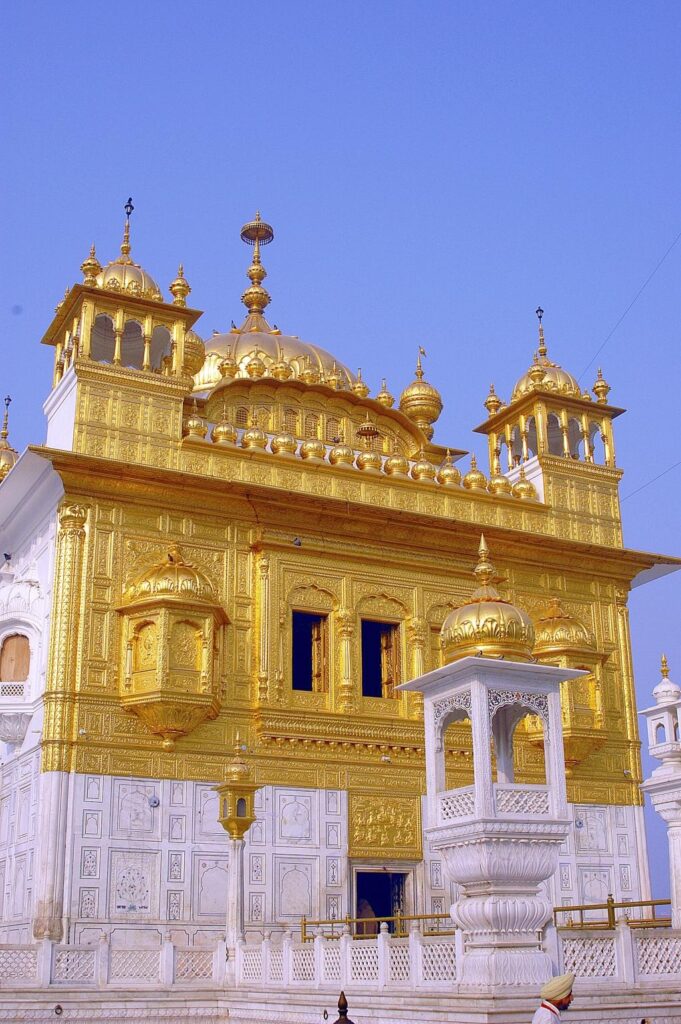
The most recognizable feature of Harmandir Sahib is its magnificent golden dome.
Unlike the pointed domes seen in many Islamic buildings, the Golden Temple’s dome resembles an inverted lotus flower.
In Indian culture, the lotus symbolizes:
- Spiritual awakening
- Purity
- Rising above worldly attachments
The dome is covered with gold-plated copper sheets, reflecting sunlight brilliantly during the day and glowing beautifully under lights at night.
Gold Plating of the Temple
Many people assume the Golden Temple is made entirely of gold.
In reality, the structure consists of:
- Brick masonry
- Marble
- Copper sheets
- Gold leaf covering the copper
The extensive gold plating was sponsored by Maharaja Ranjit Singh in the early nineteenth century.
It transformed Harmandir Sahib into one of the most recognizable religious monuments on Earth.
Marble Inlay Work
The lower section of the shrine showcases exceptional marble craftsmanship.
Visitors can admire:
- Pietra dura (stone inlay)
- Floral carvings
- Delicate borders
- Geometric symmetry
These designs were created by master artisans and remain remarkably well preserved.
Frescoes and Wall Paintings
Inside the temple, the walls and ceilings feature magnificent frescoes painted in traditional Punjabi and Mughal artistic styles.
These paintings include:
- Floral patterns
- Religious motifs
- Decorative vines
- Symbolic artwork
The artwork creates a warm and elegant atmosphere while preserving Sikh artistic heritage.
Mirror Work and Decorative Ceilings
The upper chambers of the temple are adorned with:
- Mirror mosaics
- Gold leaf decorations
- Hand-painted ceilings
- Ornamental woodwork
When illuminated, these intricate details create a mesmerizing effect that leaves visitors in awe.
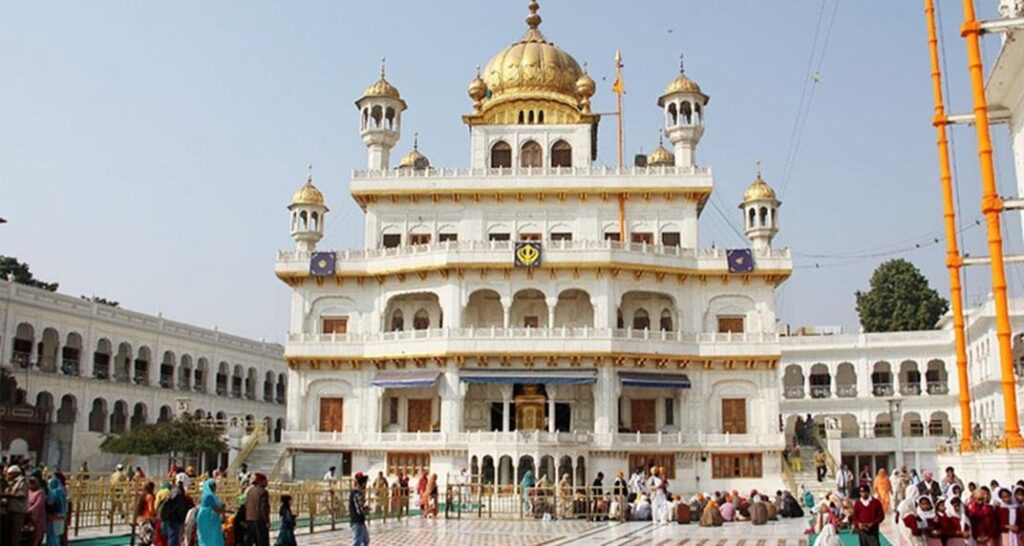
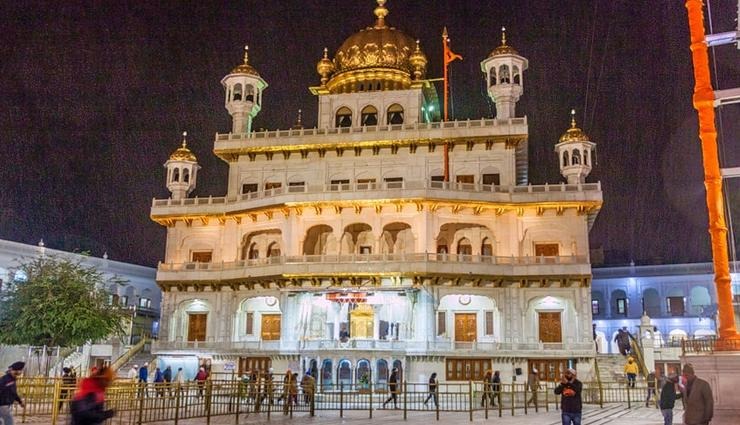
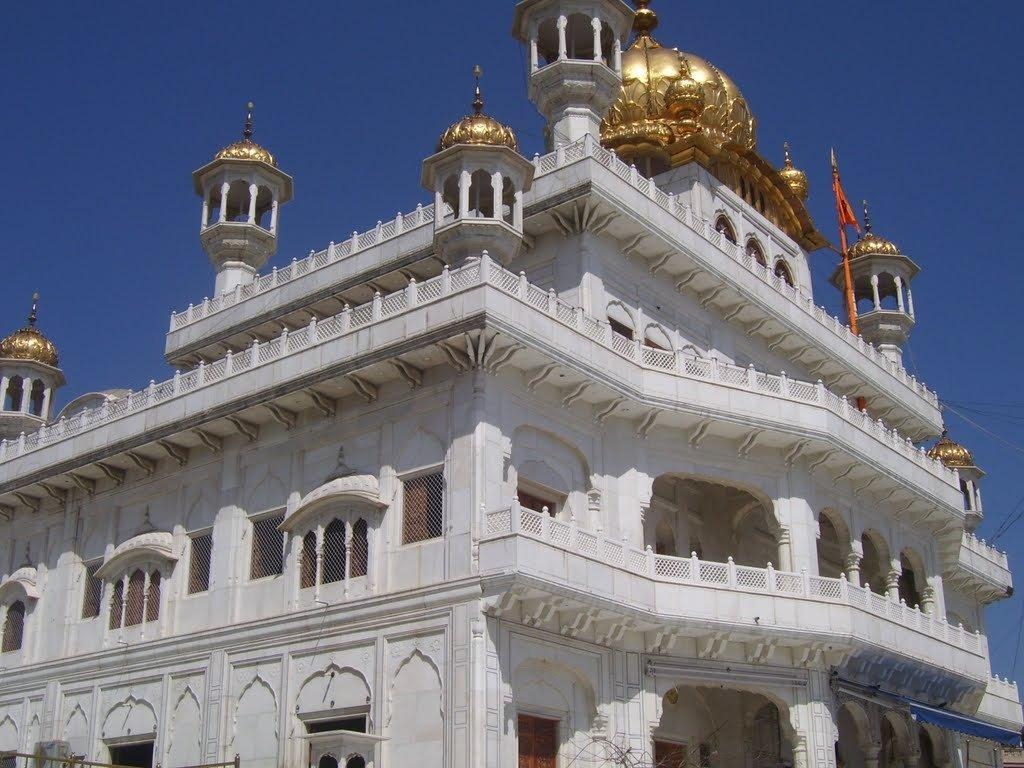
The Akal Takht
6
Directly opposite Harmandir Sahib stands the Akal Takht, meaning “The Throne of the Timeless One.”
It was established in 1606 by Guru Hargobind.
While Harmandir Sahib represents the spiritual authority of Sikhism, the Akal Takht represents its temporal and community leadership.
Important announcements, religious decisions, and community matters are traditionally addressed from here.
The Akal Takht was heavily damaged during Operation Blue Star but has since been rebuilt.
The Nishan Sahib
Towering above the complex is the Nishan Sahib, the sacred Sikh flag.
The flagpole is covered with fabric and topped with the Sikh emblem.
The Nishan Sahib symbolizes:
- Justice
- Service
- Equality
- Sikh identity
Every Gurdwara around the world proudly flies this flag.
The Historic Ber Trees
The Golden Temple complex is home to several ancient Ber (jujube) trees, each associated with important events in Sikh history.
Dukh Bhanjani Ber
This is one of the most revered trees in the complex.
According to Sikh tradition, a devotee experienced healing here through faith and prayer, leading to the name “Dukh Bhanjani,” meaning the remover of suffering.
Baba Buddha Ber
This tree is associated with Baba Buddha, who supervised parts of the temple’s early construction and became its first Granthi.
Laachi Ber
This historic tree is linked to Guru Arjan Dev and remains an important landmark within the complex.
These trees are preserved not merely for their age but for their deep historical and spiritual associations.
The Central Sikh Museum
Located within the Golden Temple complex is the Central Sikh Museum.
The museum preserves the rich history of Sikhism through:
- Portraits of Sikh Gurus
- Paintings of martyrs
- Historical manuscripts
- Traditional weapons
- Coins and artifacts
- Documents related to Sikh history
A visit to the museum provides valuable context for understanding the sacrifices and achievements of the Sikh community.
Ramgarhia Bunga
Adjacent to the complex stands the historic Ramgarhia Bunga, built by the Ramgarhia Misl in the eighteenth century.
Its twin towers once served defensive and observational purposes, protecting the sacred complex during turbulent times.
Today, they remain among the oldest surviving structures in the area.
The Clock Tower
During British rule, a Gothic-style clock tower was erected near the temple entrance.
Although it became a recognizable landmark for a time, many Sikhs felt it did not reflect the traditional architectural character of Harmandir Sahib.
The original tower was later replaced, and the entrance was redesigned in harmony with Sikh architectural aesthetics.
Symbolism Behind the Architecture
Every major architectural feature of the Golden Temple conveys a spiritual lesson:
- Four Gates – Equality and openness to all.
- Temple Below Ground Level – Humility before God.
- Bridge to the Sanctum – The focused journey toward spiritual truth.
- Amrit Sarovar – Inner purification and reflection.
- Golden Dome – Purity and spiritual enlightenment.
- Akal Takht – The balance between faith and responsibility.
- Parikrama – Reflection, devotion, and continuous spiritual progress.
Together, these elements make the Golden Temple much more than a beautiful monument—they transform it into a living expression of Sikh philosophy.
Langar, Daily Rituals, Festivals, Travel Guide, Fascinating Facts & FAQs
After learning about the history and architecture of the Golden Temple, it is time to explore what truly makes this sacred place unique. Beyond its golden walls and magnificent domes lies a living tradition of selfless service, equality, and devotion.
Every day, thousands of volunteers dedicate their time to serving others without expecting anything in return. From the world’s largest free community kitchen to the continuous singing of sacred hymns, every activity at the Golden Temple reflects the core teachings of Sikhism.
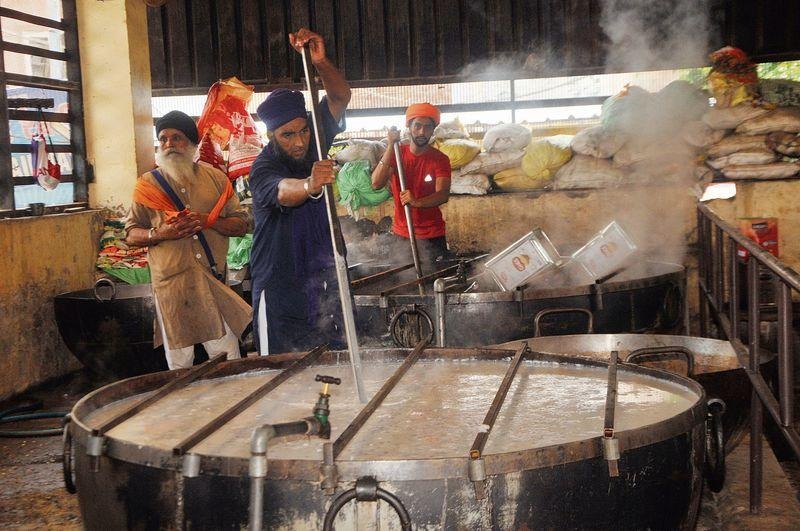
Langar: The World’s Largest Free Community Kitchen

7
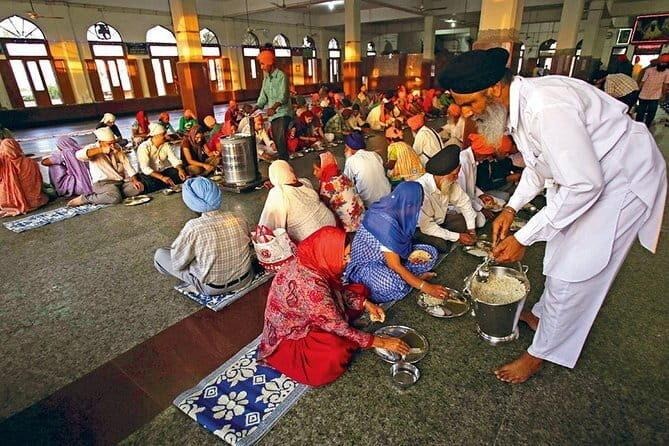
One of the most extraordinary features of the Golden Temple is its Langar, a tradition that began with Guru Nanak and was further strengthened by the later Sikh Gurus.
Langar is a free vegetarian meal served to every visitor, regardless of religion, nationality, gender, caste, or financial status. Rich and poor, locals and tourists, all sit together on the floor in long rows, symbolizing equality before God.
On many days, more than 100,000 people are served fresh meals, and during major festivals the number can increase even further.
What Is Served?
The menu is simple yet nourishing and typically includes:
- Fresh chapatis (rotis)
- Dal (lentils)
- Seasonal vegetables
- Rice
- Kheer (on special occasions)
- Drinking water
The meals are prepared using large-scale kitchens equipped with modern machines, yet much of the work is still carried out by volunteers.
Seva – The Spirit of Selfless Service
The Langar runs entirely on the principle of Seva, meaning selfless service.
Thousands of volunteers:
- Wash vegetables
- Knead dough
- Cook meals
- Serve food
- Wash utensils
- Clean dining halls
No one is paid for this work. They serve out of devotion and a desire to help humanity.
This spirit of Seva is one of the defining values of Sikhism.
Daily Ceremonies at the Golden Temple
The Golden Temple follows a disciplined daily schedule centered around prayer, music, and reverence for the Guru Granth Sahib.
1. Prakash Ceremony
Before dawn, the Guru Granth Sahib is ceremonially carried from the Akal Takht to the sanctum of Harmandir Sahib.
This ceremony, known as Prakash, marks the beginning of the day’s worship.
Devotees gather to witness this deeply spiritual procession accompanied by devotional singing.
2. Continuous Kirtan
Throughout the day, trained musicians perform Kirtan, singing hymns from the Guru Granth Sahib.
The music fills the entire complex, creating an atmosphere of peace and devotion that many visitors describe as unforgettable.
3. Ardas
Several times each day, a collective prayer known as Ardas is offered.
It expresses gratitude to God and remembers the sacrifices made by Sikh Gurus and martyrs.
4. Sukhasan Ceremony
Late at night, the Guru Granth Sahib is respectfully carried back to the Akal Takht in a ceremonial procession.
This ritual, called Sukhasan, marks the conclusion of the day’s worship.
The Guru Granth Sahib
Unlike many religions that are centered around a living religious leader, Sikhism regards the Guru Granth Sahib as the eternal Guru.
Compiled by Guru Arjan Dev and later completed by Guru Gobind Singh, it contains the teachings of the Sikh Gurus along with devotional writings of saints from different backgrounds.
This inclusiveness reflects the Sikh belief that wisdom and devotion are universal.
Major Festivals Celebrated at the Golden Temple
7
The Golden Temple becomes especially vibrant during Sikh festivals, attracting lakhs of devotees from around the world.
1. Vaisakhi
Celebrated every April, Vaisakhi commemorates the creation of the Khalsa by Guru Gobind Singh in 1699.
The temple is beautifully decorated, special prayers are held, and the atmosphere is filled with devotional music and celebration.
2. Gurpurab
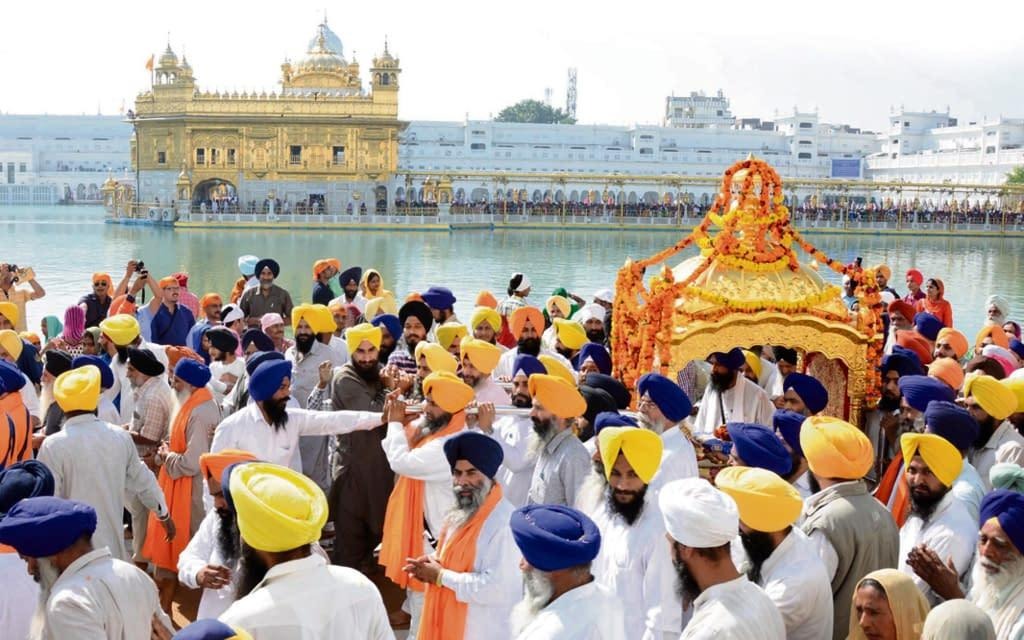
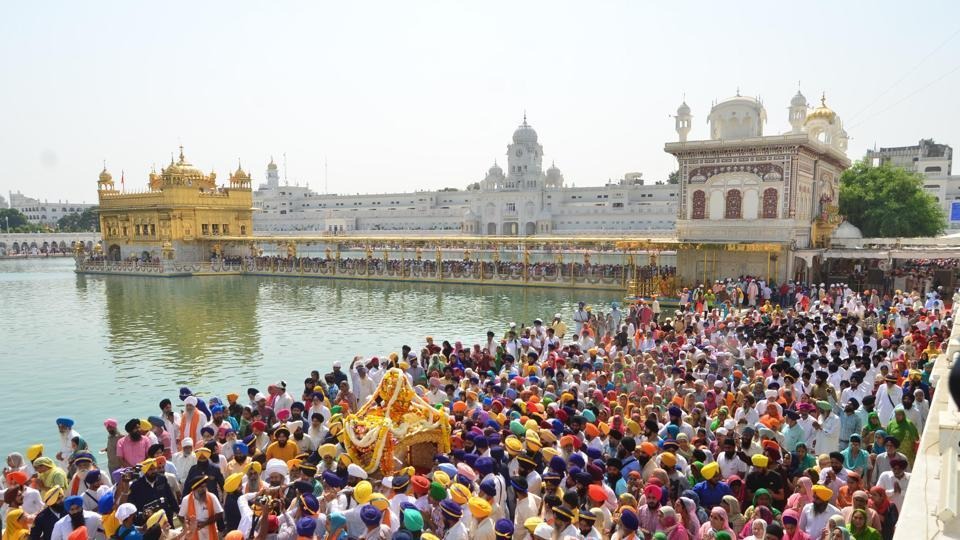
Gurpurabs celebrate the birth anniversaries of the Sikh Gurus, particularly Guru Nanak Dev Ji.
The celebrations include:
- Akhand Path (continuous scripture reading)
- Kirtan
- Nagar Kirtan processions
- Fireworks
- Langar
3. Bandi Chhor Divas
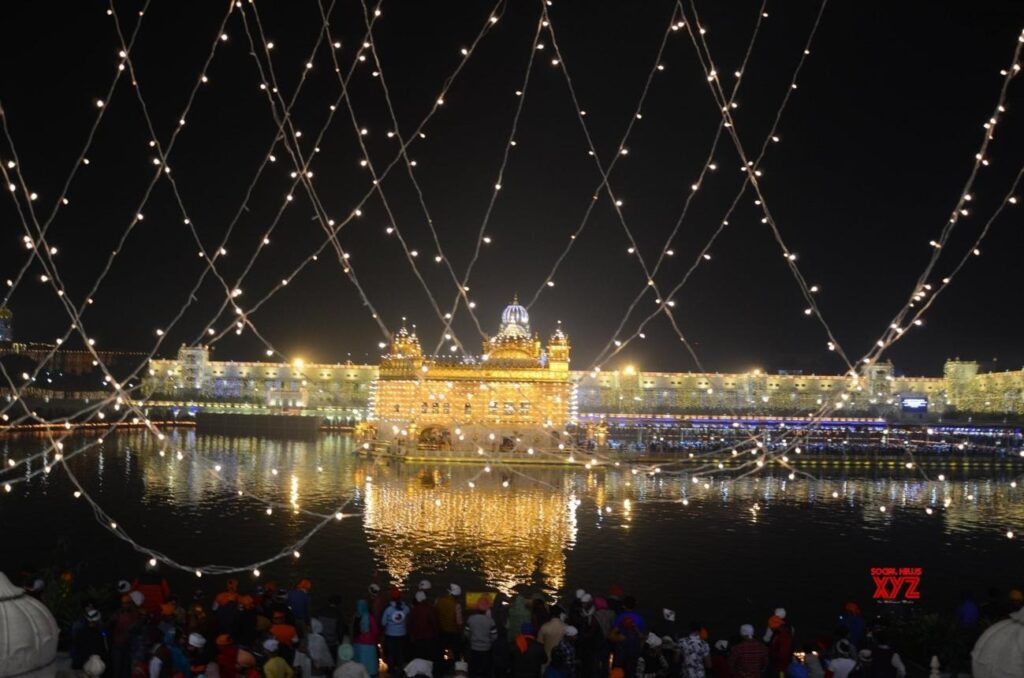
Celebrated on the same day as Diwali, Bandi Chhor Divas commemorates the release of Guru Hargobind from imprisonment.
The Golden Temple is illuminated with thousands of lights, and the reflection in the Amrit Sarovar creates one of the most spectacular sights in India.


